Why Syllabus Structure is Important
A clear syllabus helps all learners understand expectations for the course. Additionally, syllabi posting is governed by Florida Statute 1004.085 and Florida Board of Governors’ Regulation 8.003. Some of the most recent changes in requirements of syllabi is that they be published 45 days in advance of the course start date, the course Calendar include specific information (as shown below), and Methods of Evaluation include specific details and points/percentages (as shown below). In addition, Instructor Policies set forth a contract with students and may cover items like communication, grading frequency, AI statements, late work policy, etc. (as shown below). To ensure we are in compliance with these regulations, the DTL is offering support and resources to help you create an exemplary syllabus that follows best practices and ensures we meet federal requirements.
Sample Syllabus:
This sample LSSC syllabus is intended to be used as a model. We provide this resource in order to illustrate exemplar language and structure of an online course syllabus. Please see the example above and see the Syllabus Best Practices Check List from the University of South Carolina.
Relevant Syllabus Sections
Below you will find relevant sections of the syllabus along with sample language and formatting:
Calendar
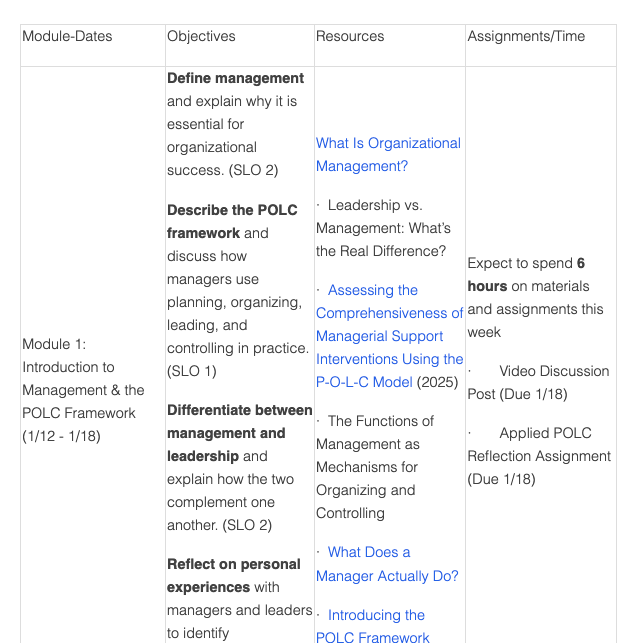
Your Syllabus Calendar should include the following components: (1) dates for when the learning/activities will occur (ex. Week 1: 1/12-1/18); (2) a list of readings and/or video content to view; (3) a list of activities and assignments to complete. It is recommended to also align the readings and assignments with learning objectives. Note: If the course is hybrid, please also include the dates in-person attendance is required.
Sample Calendar:
Methods of Evaluation
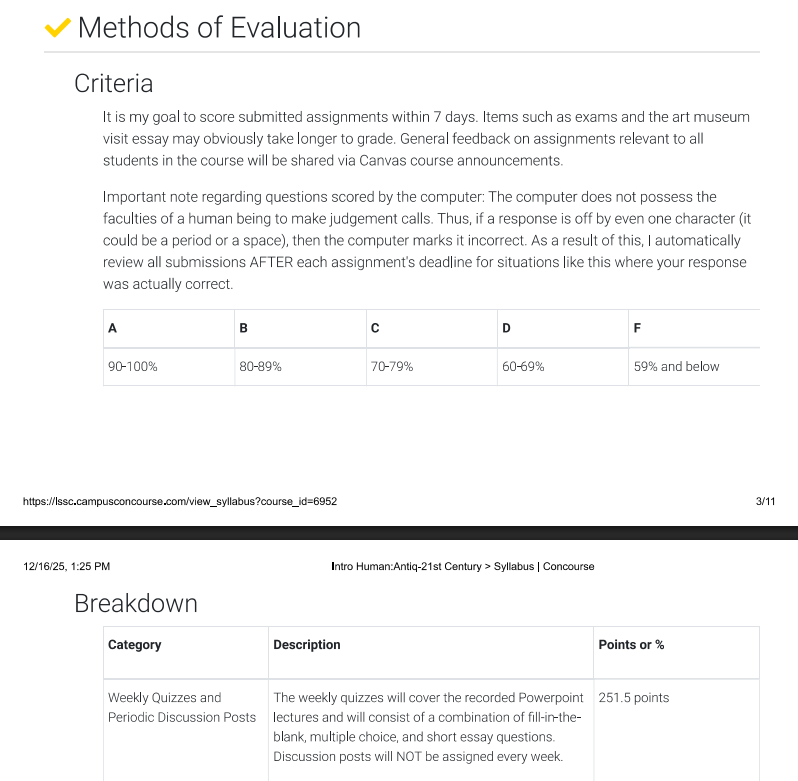
Your Methods of Evaluation section should describe in detail every way in which students will be assessed. This includes: a breakdown of each type of assessment (as categorized in the gradebook), a description of the category or activities, and how much of students’ grade it will represent in terms of total points or percentage (ex. weekly quizzes: 1150 points total or 15% of final grade).
Sample Evaluation Section:
Instructor Policies
Your instructor policies should include several smaller sections of policies you set for the course. This is your contract with students and is important for clarity and potential grievance cases. Below are a few examples of sections you may want to include in your syllabus, as well as sample language:
Communications
This is an opportunity to set reciprocal expectations on communication expectations, including frequency or responses.
Sample Language:
“It is your responsibility as a student to be aware of all course announcements. These announcements may provide reminders of course deadlines, general feedback on assignments, clarification of directions, etc. Please note that course announcements are addressed to the entire class.
I ask that all emails be sent to me through the Canvas interface. This keeps emails from students from getting mixed in with emails from administration, colleagues, national organizations, etc. I will be checking my email at least once a day from Monday through Friday. I will not respond to emails on Saturday and Sunday. I will do my best to respond to your questions and concerns quickly. Please be patient.”
Late Work Policy
This area should establish your late work policy. Do you accept late work? Is there a penalty? Be specific so students know the expectation for YOUR course. Below are some examples of late policy language from published syllabi. Yours may sound similar or different but should be present for the student.
Sample Language:
A To-Do List is provided in each course module indicating what assignments are due each week. Assignments are typically due before 11:59 PM on Sundays (finals week may result in assignments being due on different days).
Extensions for assignments/make-up exams will NOT be allowed except under extraordinary circumstances as determined by the instructor (i.e., when you can establish that events beyond your control prevented you from completing the work and you provide the appropriate documentation). It is the responsibility of the student to arrange the above with the instructor prior to the initial assignment/exam deadline. ‘I did not have internet access’ is not a valid excuse for missing course deadlines. ‘I worked until 5 PM’ is not an excuse for missing deadlines as you should be aware of assignments and not be waiting until the due date to complete them.”
OR
Assignments and exams are expected to be submitted by the stated deadline. Work submitted after the deadline will be accepted with a 10% deduction of the total possible points for each day it is late. For example, an assignment worth 100 points will receive a 10-point deduction for each day past the deadline.
Students who anticipate difficulty meeting a deadline should contact the instructor before the due date to discuss possible options. Extensions beyond the standard late policy will only be considered under extraordinary circumstances (e.g., significant events beyond your control) and may require appropriate documentation.
Please plan ahead and allow adequate time to complete and submit your work. Statements such as “I did not have internet access” or “I worked until 5 PM” are not considered valid reasons for missing course deadlines, as students are expected to manage their schedules and submit assignments on time.
OR
If you anticipate that you will need to submit an assignment late, please contact the instructor prior to the due date. Doing so allows the instructor to understand that you are still actively participating in the course and working through the material, even if unexpected circumstances arise. Life happens, and communication helps ensure that we can work through challenges while keeping you on track in the course.
AI Statement
“Lake-Sumter State College’s Quality Enhancement Plan is dedicated to information fluency. As information fluency includes AI literacy, specific assignments in this course will offer you the opportunity to promote your critical thinking and stimulate creativity with the assistance of generative AI tools (ChatGPT, Gemini, etc.). You are permitted to use AI only in the manner and means described in each assignment. Any attempt to represent AI output inappropriately as your own work will be treated as plagiarism.
The following general expectations of students’ interaction with generative AI apply to the entire course. Instructors should select ONE for the overall approach to the course, while a given assignment may have specific AI use policy in its instructions.
Sample Language:
- Use of AI prohibited. Only some Artificial Intelligence (AI) tools, such as spell-check or Grammarly, are acceptable for use in this class. Use of other AI tools via website, app, or any other access, is not permitted in this class. Representing work created by AI as your own will result in a failing grade on the assignment as it violates course policy, regardless of acknowledgement of use or citation. Check with your instructor to be sure of acceptable use if you have any questions.
OR
- Use of AI only with explicit permission. This class will make use of Artificial Intelligence (AI) in various ways. You are permitted to use AI only in the manner and means described in the assignments or outlined in the course resource pages regarding permitted AI use. Any attempt to represent AI output inappropriately as your own work will be treated as plagiarism.
OR
- Use of AI only with acknowledgement. Students are allowed to use Artificial Intelligence (AI) tools on all written assignments if the usage is properly documented and credited per instructor standards (APA, MLA, etc.). For example, text generated from CoPilot should include a citation such as: “CoPilot. Accessed 2023-12-03. Prompt: ‘Summarize the Geneva Convention in 50 words.’ Generated using http://bing.com/chat.”
Plagiarism
While the pre-populated Academic Integrity section provides a blanket statement, instructors may want to be more specific as to what constitutes plagiarism in their course. What are the consequences of plagiarism or academic dishonesty in your course?
Classroom Etiquette
What is your expectation for classroom discussion, norms, and behavior? How do you expect students to behave/write/speak in the online components of your classroom? Be sure to give a clear picture to students.
Remember, your syllabus is your contract with students. As you build your syllabus for the first time since new legislation was implemented, you are encouraged to speak with your Dean/Supervisor to get any clarification you need. Make it a great semester!
Textbook and Instructional Materials
All course syllabi must include the required and recommended textbooks and instructional materials, as per Florida Statute 1004.085 on textbook and instructional materials affordability and transparency. For textbooks, be sure to structure them with the following components: an image of the book cover, a required or recommended designation, book title, author(s), Publisher, edition, and ISBN. If an ISBN is not available, include the copyright date, publication date, and any other relevant identifying information. Also, be sure to include any other required instructional material, such as an access code, lab manual, software/license, digital platform, workbook, or other course material.
While the Rule specifies that the syllabus must include the required and recommended textbooks/instructional materials section, LSSC requires faculty to include the detailed ISBN/metadata directly in the syllabus.
Sample Language:
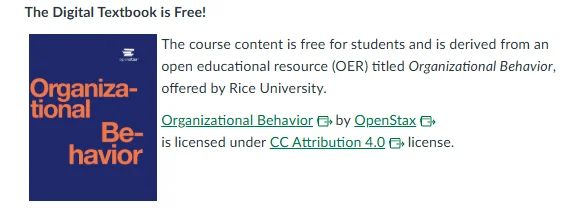
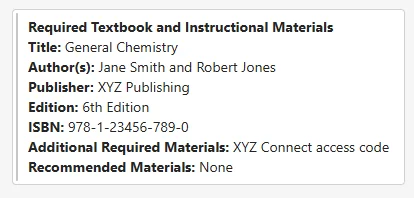
If there is no textbook, be sure to state “no textbook required” rather than leaving the section blank. For a zero-cost/OER course, be sure to indicate the course is zero-cost.
Sample language for zero-cost course:
“There are no textbooks or commercial course materials required for purchase for this course. All required readings, instructional guides, and learning resources are written directly by the instructor and embedded seamlessly within each weekly Canvas module. You will have full, free digital access to all content from day one via your web browser or the Canvas app. Reliable internet access and a device capable of navigating Canvas are all that you need to access your materials.”