Specialized Associate in Arts Transfer (SAAT)
Electrical Engineering
Help Power the Technology that Shapes Our Daily Lives
The Specialized Associate in Arts Transfer (SAAT) degree in Electrical Engineering prepares students for transfer as juniors to a Bachelor of Science in Electrical Engineering degree program. Electrical engineers create, design, produce, operate, and maintain the technologies and systems that power modern society, while developing innovative solutions to future challenges through advances in science and technology. This SAAT degree provides a structured pathway for students pursuing careers in electrical engineering and related fields. Students are required to meet all requirements listed in the relevant Articulation Agreement in order to complete this degree.
Please Note: This program will be available for enrollment starting in the Spring 2027 semester.
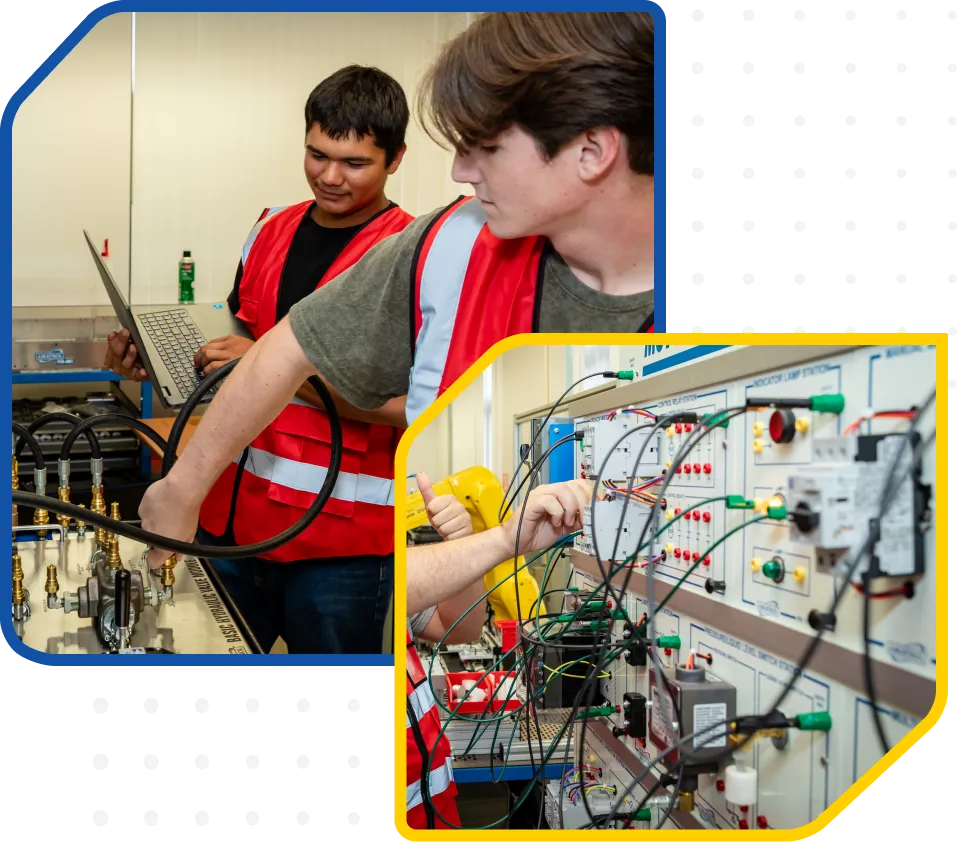
Overview
The Specialized Associate in Arts Transfer (SAAT) degree in Electrical Engineering at LSSC prepares students for a seamless transfer into the Bachelor of Science in Electrical Engineering program at UCF. By aligning lower-division coursework, this degree provides guaranteed acceptance* to the UCF Electrical Engineering program once all requirements are met.
If you prefer a more flexible transfer pathway that keeps multiple university options open, consider the AA Engineering Pathway, which provides a broader foundation for transfer to universities across Florida.
Why start at LSSC?
- Affordability: Complete your degree at half the price of state universities.
- Guaranteed Transfer*: Secure admission to the UCF Bachelor of Science in Electrical Engerneering program.
- Flexible Learning: Courses are available at four campuses, in hybrid formats, or online.
- Supportive Environment: Benefit from small class sizes and personal academic and career advising from your first day.
- Financial Aid: Various grant and scholarship programs are available to assist with costs.
* Consistent with university policy
Program Length
The program consists of 60-89 credit hours and can be completed in less than three years when attending full-time.
Program Cost
Tuition costs for programs and courses at the associate’s degree level are $109.73 per credit hour. Additional costs will include textbooks, materials, and course fees.
Program Cost DetailsScholarships
Students graduating from high school and enrolling at LSSC may qualify for other scholarships offered through the State of Florida. You will be notified of your eligibility after you apply to the College.
Scholarship DetailsFinancial Aid
There are many options to finance your education. You may be eligible for Federal Grants, Work-Study, State Grants, Federal Loans, and Institutional Scholarships. For more information and how to apply, please visit the Financial Aid page.
Financial Aid DetailsOutlook
Electrical engineering graduates are well-prepared for high-growth careers in engineering.
- Architectural and Engineering Managers: 8.5% projected growth
- Aerospace Engineers: 14.9% projected growth
- Computer Hardware Engineers: 9% projected growth
- Electrical Engineers: 8% projected growth
- Electronics Engineers (excluding Computer Engineers): 9.7% projected growth
Career Outlook
Designed to provide students the opportunity to complete the first two years of a bachelor’s degree for employment requiring that level of degree attainment.For a detailed breakdown of the curriculum and degree requirements, visit the Catalog page.
What is the SAAT in Electrical Engineering?
The Specialized Associate in Arts Transfer (SAAT) degree is a pathway designed specifically to align with the bachelor’s degree program in Electrical Engineering at the University of Central Florida (UCF). If you’re considering this program with the goal of attending a university other than UCF for your bachelor’s degree, please discuss your interests with an Academic Advisor.
Credit Breakdown: While a general AA focuses on general education and electives totaling 60 credits, the SAAT includes required major prerequisites and core coursework, meaning it can require 60-89 credits total depending on your background in math, sciences, and foreign language.
The UCF Advantage: Completing the SAAT ensures you are ready for upper-division admission and reduces your time to degree after you transfer. Students who complete the program will be admitted to UCF and into the College of Sciences as an electrical engineering major.
Diploma Recognition: Students who successfully complete the pathway will have “Specialized Associate in Arts Transfer Degree” reflected on their diplomas.
Admissions: This program is open to all students admitted to the institution, with the same admission requirements as the standard AA program. There is no separate application process. Click here to apply for admission.
Coursework: The pathway requires 36 credits of general education, plus specific science sequences in Chemistry and Physics, as well as Calculus, Differential Equations, and electives. Click here for a breakdown of the required coursework.
Grades: All courses within the program pathway must be completed with a grade of “C” or better. There are no additional GPA requirements for entrance.
Flexibility: Courses are offered in a mix of face-to-face, hybrid, and fully online modalities, and can be taken on a full-time or part-time basis.
Financial Aid: Participating in the SAAT pathway does not change your eligibility for financial aid, scholarships, or grants. Click here to learn more about Financial Aid.
Excess Hours: Any credits taken outside of the defined SAAT credits will be considered excess hours and will not be eligible for financial aid. Federal financial aid will only pay for courses required for the degree or eligible certificate, including remedial coursework. Courses listed under “Courses Not Counted Toward Program” on a Degree Audit will not receive federal funding.
Fall Term (Prior to Spring 2027 Launch): Payment expectations will be situational based on the student’s declared program of study leading up to the fall launch. Non-degree-seeking students will likely need to pay out of pocket or explore options with Financial Aid.
Transferring Elsewhere or Changing Majors: The guaranteed alignment and admission only apply to UCF. Because the SAAT is major-specific, changing your major may reduce these alignment benefits. However, you have the option to switch back to a regular AA pathway at any time, though you may have to meet new requirements. Please be sure to discuss your plans with an Academic Advisor.
Timeline at UCF: Once transferred, you will need an additional 60-68 credits of upper-level engineering courses at UCF, which can be completed in as little as 4 semesters, depending on your course load. It is expected that you can start at UCF immediately after completing the SAAT, provided you meet deadlines and other admission requirements.
The time needed to complete the SAAT in Electrical Engineering degree depends on the number of credits earned each semester. If a student enrolls full-time, the pathway can be completed in 2-3 years.
Coaching & Guidance: SAAT students will be assigned an Academic Advisor for support while enrolled at LSSC. Advisors must ensure students complete the DirectConnect to UCF form so they are connected with a UCF Success Coach for guidance leading up to enrollment. You may also complete the DirectConnect to UCF form here.
Electives: Electives are specifically built into the pathway to fulfill both the SAAT requirements and support the baccalaureate prerequisites.
Admission Timing: DE students cannot be admitted into the SAAT program until they have graduated from high school. However, advisors can help them plan for it and complete requirements while still in DE.
Application Process: When transitioning to a traditional college student after high school, DE students must submit a readmit application and select the appropriate SAAT. If a DE student initially submits a readmit app for a general AA and later decides to switch, they must submit a program change form. For support with this process, contact our Enrollment Service Center.
UCF Classification: If a student completes the SAAT as they graduate high school and goes directly to UCF for their first term, they are classified as First-Time-in-College (FTIC). If they enroll at our institution or another college after high school graduation, before heading to UCF, they are considered a Transfer.
Application Process
A student must have a high school diploma or GED to apply to Lake-Sumter State College.
01
Submit your Application
Submit your online application and $30 application fee
02
Transcripts
Submit high school/GED and prior college/university transcripts
03
Financial Aid
Complete the FAFSA and other financial aid forms
Our team is ready to support you!
Why Choose LSSC
Over 11,000
Students
26+
Degrees & Certificates
30:1
Student To Faculty Ratio
30+
Clubs & Organizations
1st
Students First. Always.
Fastest
GROWING COLLEGE IN FLORIDA
Relevant Programs & Resources

Associate in Arts
Engineering

Specialized Associate in Arts Transfer (SAAT)
Civil Engineering